iMumz.
Led a four-engineer mobile team at iMumz: 1M+ Android downloads, 60K+ monthly active users, and a fertility product built from concept to production in 3–4 months.
- My contribution
- I led four engineers, owned modular architecture and Server-Driven UI, and built a fertility app from concept to production in 3–4 months.
- The constraint
- Grow a maternal-health product suite while protecting the experience people already depend on.
- The decision
- Modular feature boundaries, Server-Driven UI and instrumented critical paths keep new products and existing journeys moving together.
 THE MATERNAL HEALTH PLATFORM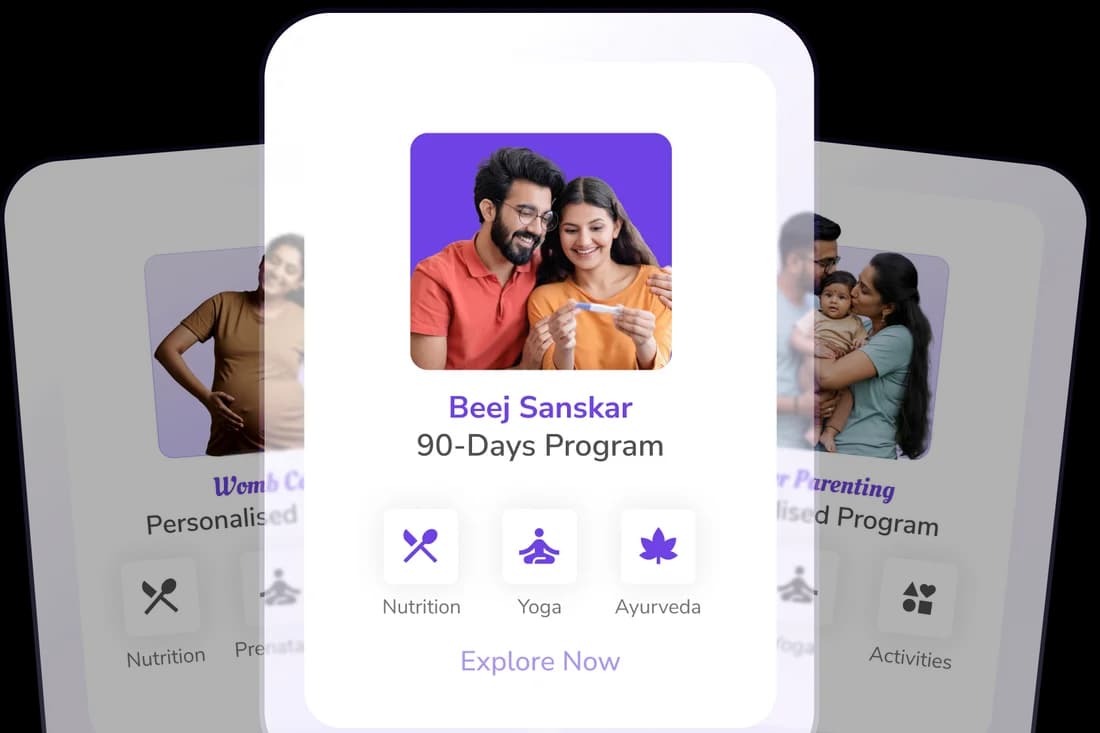
DELIVERY & ENGINEERING OUTCOMES
What I took ownership of.
iMumz runs a maternal health platform: products with 1M+ Android downloads, 60K+ monthly active users and 15K+ daily active users, a fertility product, a consultation business, and the web surface that feeds all of it. From June 2024 to September 2026, I owned mobile across that estate as SDE-2 — building the fertility app from concept to production in 3–4 months for 2,500+ couples, launching the doctor consultation platform, re-architecting imumz.com on Next.js, unifying subscription entitlements across four client applications, and leading a 4-engineer mobile team.
One pregnancy app, and a product surface growing faster than the mobile team.
The pregnancy app already carried 100K+ mothers, so nothing could regress. At the same time the business needed a fertility product for couples trying to conceive, a way to actually monetise doctor time, a web presence that could be found organically, and one coherent notion of what 'premium' meant across four separate client applications. All of that had to land through a small mobile team without the flagship losing stability.
- No fertility product for couples pre-pregnancy — a whole segment unserved
- Doctor consultations had no in-app booking or payment path
- imumz.com couldn't be rendered or indexed well enough to earn organic traffic
- Four client apps each reasoned about premium access on their own terms
- Runtime crashes and onboarding drop-off were unmeasured, so unfixable
Instrument what exists, then build what doesn't.
The order mattered. Crashlytics, analytics funnels, and A/B testing went into the existing pregnancy app first, so the team could tell a real regression from a rumour and could argue about onboarding with data. Only then did we take on new surfaces — the fertility app, the consultation platform, the web re-architecture — each of which shipped against that same telemetry baseline. Entitlements were unified last, once there were four apps to unify.
Modular feature boundaries and Server-Driven UI
Evolved feature boundaries across state, networking, presentation and navigation. Server-Driven UI lets mobile experiences be configured remotely, reducing dependence on frequent client releases while the platform serves 1M+ Android downloads, 60K+ MAU and 15K+ DAU.
Read all 7 decisions together
Modular feature boundaries and Server-Driven UI
Evolved feature boundaries across state, networking, presentation and navigation. Server-Driven UI lets mobile experiences be configured remotely, reducing dependence on frequent client releases while the platform serves 1M+ Android downloads, 60K+ MAU and 15K+ DAU.
Fertility app as its own product, not a mode
Couples trying to conceive have a different data model and a different cadence than pregnancy. Forcing it into the flagship would have meant conditionals on every screen. Built it as a separate cross-platform app and shipped concept → production in 3–4 months: nutrition planning, medication tracking, doctor consultations, appointment booking, and yoga monitoring.
Crashlytics and analytics funnels before feature work
Personalized onboarding by user goals, device characteristics and city tier, using analytics funnels and A/B tests to improve completion ~43%. Crashlytics root-cause analysis, lifecycle fixes, defensive state handling and error-path improvements reduced production crashes ~67%.
Consultations as a first-class revenue surface
Doctor availability, booking, and payment built end-to-end rather than bolted onto content. Razorpay Pay Later was included because cost is the friction point at the decision moment, not the browsing moment.
Centralised entitlements over per-app subscription logic
Four client applications each deciding what a subscriber can see is four places to get it wrong. One entitlement system, with deep links carrying users across apps, so premium access resolves the same way on mobile and web.
SSR for the web surface, custom CMS for the people writing it
imumz.com moved to Next.js with SSR and SEO fundamentals so content could actually be indexed, and onto a custom CMS so publishing didn't require an engineer.
Structured meeting outcomes from Google Meet transcripts
Built a Python-based LLM pipeline for transcript ingestion, preprocessing and prompt orchestration, producing structured meeting summaries, decisions and action items.
A mobile estate that ships new products without destabilising the old one.
Four client applications, one entitlement model, one telemetry baseline, and a team that reviews its own architecture. New products land as products, not as branches inside the flagship.
- Fertility app built concept → production in 3–4 months, serving 2,500+ couples
- Consultation platform live with 15+ doctors and 1,000+ appointments/month, including Razorpay Pay Later
- imumz.com re-architected on Next.js + SSR with a custom CMS — 38K+ monthly organic visits
- Unified subscription entitlements across four client applications via deep links
- Led 4 engineers through sprint planning, architecture reviews, and 250+ PR reviews
- Mentored 2 junior engineers to independent feature ownership
- Server-Driven UI for remotely configured mobile experiences
- Python LLM pipeline for structured meeting summaries, decisions and action items
The work, measured.
Onboarding completion
Personalized journeys and A/B tests used user goals, device characteristics and city tier to address measured drop-off in the onboarding funnel.
Runtime crashes
Crashlytics-driven root-cause analysis, lifecycle fixes, defensive state handling and better error paths improved production reliability.
Appointments / month
The consultation platform went from nothing to a revenue-generating service with 15+ doctors booking through it.
Monthly organic visits
imumz.com after the Next.js + SSR + SEO re-architecture, with a custom CMS the content team runs without engineering.
| Metric | Before | After |
|---|---|---|
| Fertility product | 0 — no offering for couples trying to conceive | Shipped concept → production in 3–4 months, serving 2,500+ couples |
| Doctor consultations | 0 — no in-app booking or payment path | 15+ doctors and 1,000+ appointments/month, with Razorpay Pay Later |
| Subscription entitlements | Resolved independently inside each of 4 client applications | 1 centralised entitlement system, deep-linked across mobile and web |
Built with purpose.
Mobile
- Flutter
- Dart
- Android
- iOS
- BLoC
Web
- Next.js
- SSR
- Custom CMS
- SEO
Architecture
- Feature-Based Architecture
- Server-Driven UI
Automation
- Python
- LLM Pipelines
- Prompt Orchestration
Platform
- Firebase
- REST APIs
- Razorpay
- Deep Links
Quality
- Crashlytics
- Analytics Funnels
- A/B Testing
“Yashraj consistently demonstrates full ownership of projects, ensuring timely delivery with precision and attention to detail.”
Android, Kotlin & Flutter · Bengaluru & remote teams.
Send the role and a little about your team. I’ll take it from there.